The National Smallsat Programme is a landmark project in the history of Greece’s domestic space activities.
It is funded by the European Union’s Recovery and Resilience Facility and aims to upgrade the country’s space infrastructure.
The programme is being implemented by the General Secretariat of Telecommunications and Post of the Ministry of Digital Governance, with the assistance and support of the European Space Agency (ESA) and the Hellenic Space Center.

An umbrella programme which includes the following sub-programmes:
- A constellation of 13 Earth-observation microsatellites with the associated added-value services.
- A programme of 11 experimental cubesats for In-Orbit Validation.
- Greek Assembly, Integration and Testing (AIT) infrastructure at the Hellenic Aerospace Industry.
- Upgrading 3 observatories for optical communication with satellites.
- Hellenic Space Debris Tracking Radar.
The programme’s goals are:
- To meet the needs of the Greek public sector for Earth-observation services and products from space.
- To strengthen domestic capabilities for secure connectivity and communications.
- To support the development of the domestic Space Ecosystem.
13 Earth-observation microsatellites
The programme provides for the development of a constellation of microsatellites owned by the Greek public and specialized in Earth observation.
These satellites will be placed in low Earth, sun-synchronous orbit (LEO) around the Earth, so they can capture high-quality, high-resolution images and pass over Greek territory from south to north at the same local time every day, with the timing adjusted to each application. The low orbit also increases the frequency of data acquisition. The same satellite will pass over the country about 14 times a day.
Microsatellites are relatively small satellites (about 0.5 m x 0.5 m x 0.5 m, weighing a few hundred kilograms), but they are highly capable thanks to the integration of cutting-edge technologies.
The miniaturization of technologies, combined with the falling cost of access to space, has given a major boost in recent years to so-called New Space applications, of which microsatellites are a key element.
As prerequisites for the participation of the interested company consortia in the contracts bidding for building the satellites, they were required to feature at least 30% participation from Greek companies and to open offices and satellite -or components- manufacturing facilities, as well as ground stations, in Greece. As a result, 57 partners ultimately took part, 50 of whom are based in Greece.
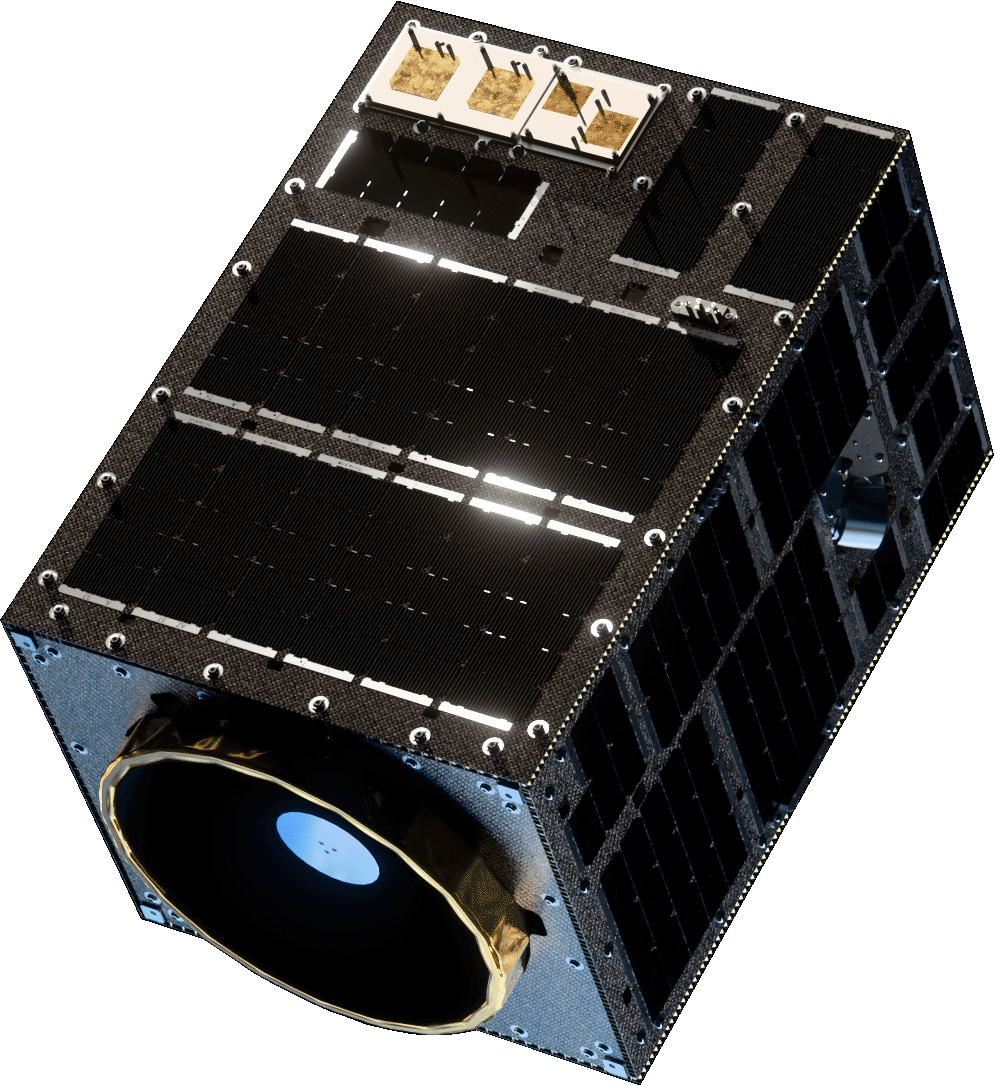
7 Optical Satellites
• 5 x HR (1.65 PAN-VNIR, 3.3 m VNIR, 19.3 m SWIR, 17.6 m HS VNIR)
• 2xVHR (0.9 m PAN, 4 m VNIR)
1 Ground Station Εδάφους, Greek Offices, ΑΙΤ, Investment Plan
Satellites status: Hyperion GR-1 in orbit since 07-07-2026. The remaining ones are awaiting launch.
4 Thermal Satellites
1 Ground Station, Greek Offices, R&D Lab, Investment Plan
Satellites status: In-orbit since 05-03-2026
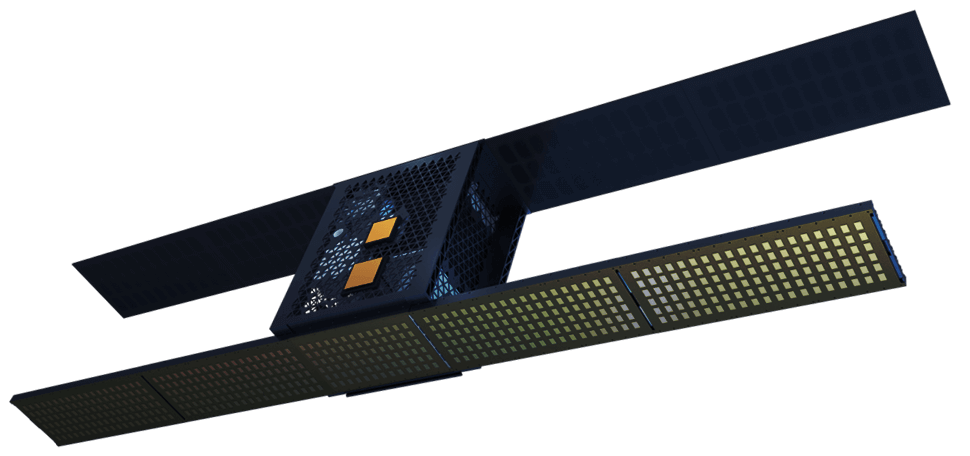
2 SAR Satellites
Greek Offices, AIT, Investment Plan
Satellites status: In-orbit since 10-28-2025
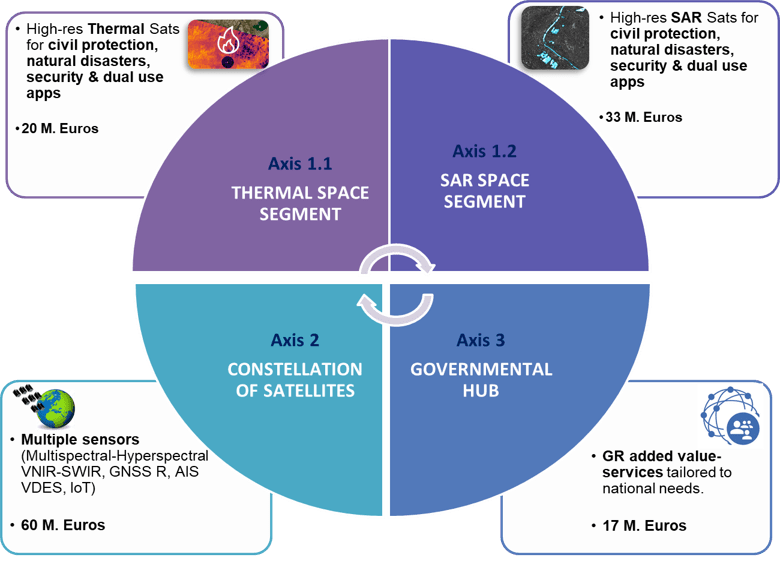
A key part of the programme is Axis 3, the so-called Governmental Hub (GovHub), where data from the microsatellites will be collected and processed to produce value-added products tailored to Greece’s national needs.
Another important part is the Earth Observation Satellite Mission Planning and Control Center – Tasking Team, belonging to the HSC and housed in its facilities. Its role is to receive orders of earth observation data from interested public bodies and users, schedule their acquisition through the Greek microsatellites or through commercial satellite-data providers, carry out first-level processing to ensure basic usability, and distribute the data. The data sources also include Greek microsatellites as well as commercial satellite-data providers such as Airbus, Maxar, Planet, and others.
More information:
Press Release of Ministry of Digital Governance – 07/02/2024
Press Release of Ministry of Digital Governance – 11/14/2024
General Secretariat of Telecommunications and Post – National Smallsat Programme
Open Cosmos – OpenConstellation
OroraTech – Greece First Country to Build a National Wildfire System using OroraTech Technology
Programme of 11 experimental cubesats for “In-Orbit Validation” (Greek IoV)
The programme consists of 7 missions involving a total of 11 cubesats. Cubesats are very small satellites, typically about 0.1 m x 0.1 m x 0.1 m and usually up to 10 kilograms, with relatively limited capabilities.
The programme aims to test new technologies in orbit and to help develop the participants’ expertise.
The first satellite of the programme, DUTHSAT-2 of Democritus University of Thrace, was launched on 23 June 2025 from Vandenberg Space Force Base in the United States aboard a Falcon 9 rocket as part of SpaceX’s Transporter-14 mission.
More Information:
| Mission | Mission patch | Organizations | # of satellites | Satellite size | Goals | Launch Date |
|---|---|---|---|---|---|---|
| Phasma |  | Libre Space Foundation | 2 | 3U | ΑDetection of radio-frequency signals and monitoring for improved space domain awareness. | 28 November 2025 |
| OptiSat | Planetek Hellas | 1 | 6U | Optical Earth observation, secure communications with autonomous decision-making capabilities through Artificial Intelligence and Machine Learning, and cloud computing technologies. | 30 March2026 | |
| PeakSat |  | Aristotle University of Thessaloniki, Prisma Electronics | 1 | 3U | Laser optical communication links with ground stations in Greece. | 14 February 2026 |
| MICE-1 |  | Prisma Electronics, Democritus University of Thrace | 1 | 3U | Maritime monitoring through reception of Automatic Identification System (AIS) signals and Internet of Things (IoT) communication. | 28 November 2025 |
| DUTHSat-2 | Democritus University of Thrace, ATHENA – Research and Innovation Information Technologies, Space Asics, Prisma Electronics | 1 | 6U | Detection of oil spills and soil moisture monitoring through remote sensing with visible and near-infrared imagery. | 23 June 2025 | |
| ERMIS |  | National and Kapodistrian University of Athens (Department of Aerospace Science and Technology), University of Patras, University of the Aegean, National Observatory of Athens, OQ Hellas | 3 | 2 6U 1 8U | Support for Internet of Things (IoT) applications, inter-satellite communications, hyperspectral imaging for precision agriculture, and optical telecommunications. | 30 March 2026 |
| Hellenic Space Dawn |  | EM Tech Space, Integrated Systems Development, Heron Engineering, Leo Space Photonics, Geosystems Hellas | 2 | 8U | Validation of space-based data processing hardware, Earth observation, and demonstration of secure optical telecommunications and inter-satellite links. | 3 May 2026 |
Greek Assembly, Integration and Testing (AIT) facilities at the Hellenic Aerospace Industry
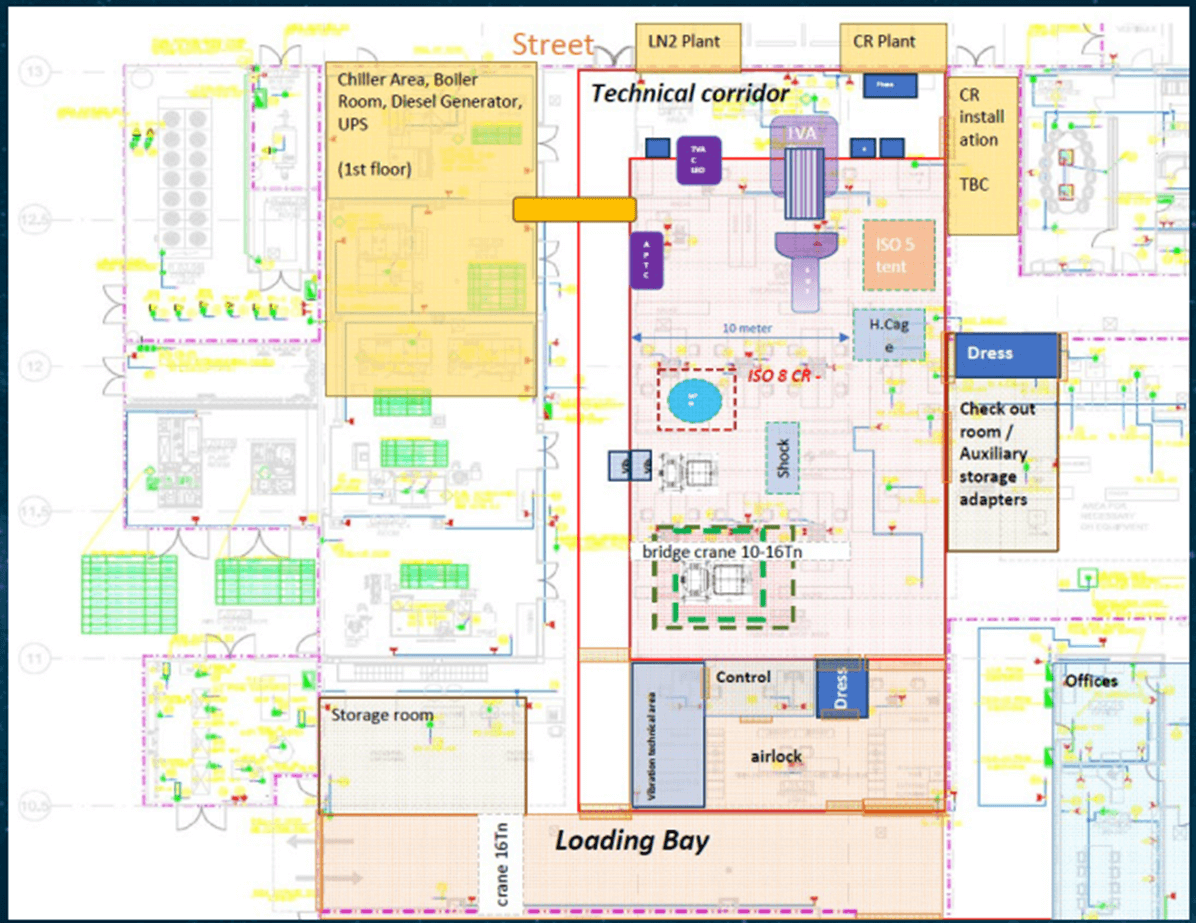
The programme provides for the construction of new infrastructure at the facilities of the Hellenic Aerospace Industry, adding the capability for carrying out assembly, integration, and testing (AIT) of microsatellites weighing up to 500 kilograms. The plan also includes the construction of a 350 sq.m. clean room.
More information:
Hellenic Aerospace Industry Press Release – 03/01/2024
Upgrading 3 observatories for optical communication with satellites
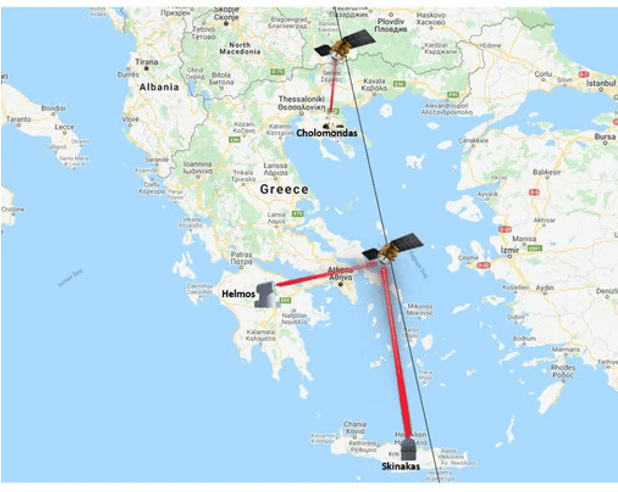
The programme includes the upgrade of three observatories across Greece with satellite-communication systems using optical laser technology:
- Holomondas Astronomical Station – Aristotle University of Thessaloniki.
- Skinakas Observatory – University of Crete & Foundation for Research and Technology – Hellas (FORTH).
- Helmos Observatory “Aristarchos” – National Observatory of Athens.
High-security communication and very high data transmission speeds will be achieved to and from satellites placed in low Earth orbit.
Hellenic Space Debris Tracking Radar
The Hellenic Debris Tracking Radar is a programme under the National Smallsat Programme, funded through the Recovery and Resilience Facility, and being developed by Celestia TTI via ESA.
It is a state-of-the-art radar for tracking satellites and orbital debris and is expected to significantly enhance Greece’s and Europe’s capabilities in the critical field of Space Situational Awareness (SSA), especially monitoring in low Earth orbit (LEO).
The radar is being built in the Hymettus area and will be able to track objects as small as 5 cm at a distance of 1,000 km, making a major contribution to Europe-wide forecasting of re-entry events and collision avoidance in orbit.